
Watch Theft and Counterfeit Statistics
Every credible public number on watch theft, counterfeiting, seizures, recovery, and the pre-owned market, each with its source and year, updated quarterly.
This page collects every credible public statistic on watch theft and counterfeiting in one place, each number followed by its source and the year it refers to. Nothing here is an estimate of ours. Where a widely repeated figure could not be traced to a primary source, it does not appear. The page is revised quarterly, and every revision is listed in the changelog at the bottom.
The five most quotable numbers, for anyone citing this page:
- Global trade in counterfeit goods reached $467 billion in 2021, about 2.3% of all global imports (OECD/EUIPO, 2025).
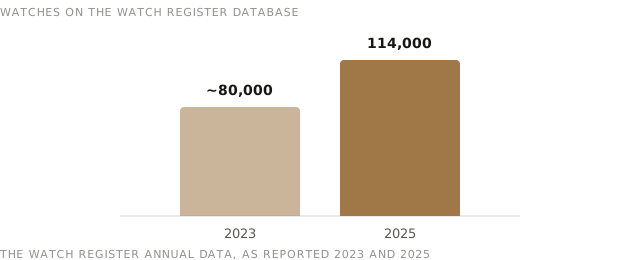
- 114,000 watches, with a total estimated value of £1.7 billion, are recorded lost or stolen on The Watch Register database (The Watch Register annual data, 2025, via Robb Report).
- In 2025, 10,000 watches were registered lost or stolen, roughly one luxury watch every hour (The Watch Register, 2025, via CityAM).
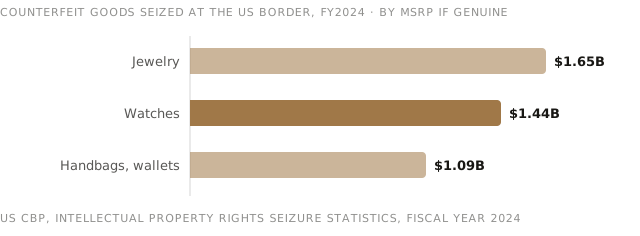
- Counterfeit watches seized at the US border in fiscal year 2024 carried a suggested retail value of $1.44 billion had they been genuine (US Customs and Border Protection, FY2024).
- Rolex accounted for 51% of watches registered lost or stolen in 2025 (The Watch Register, 2025, via Robb Report).
How big is the counterfeit watch trade?
The global trade in counterfeit goods of every kind was valued at approximately $467 billion in 2021, accounting for 2.3% of total global imports, according to the OECD and EUIPO's most recent joint study (OECD, Mapping Global Trade in Fakes, 2025). Counterfeits entering the European Union alone were estimated at $117 billion, or 4.7% of EU imports (OECD/EUIPO, 2025).
Watches sit unusually deep inside that trade. The Federation of the Swiss Watch Industry has long estimated that around 40 million fake watches are produced every year, more than the roughly 30 million genuine watches Switzerland makes (FH estimate, via the FHH Journal). An OECD study for the Swiss Federal Institute of Intellectual Property put the global trade in fake "Swiss" watches at CHF 3.35 billion in 2018, 48% of the total value of all counterfeit Swiss goods (FH, 2021), and found the watch industry losing CHF 2 billion a year in foregone sales (FHH, citing the OECD/IPI study).
The OECD's 2025 follow-up put the global trade value of counterfeits infringing Swiss intellectual property at $4.7 billion in 2021, with Swiss industries losing an estimated $3 billion in sales and more than 6,000 jobs (OECD, Counterfeiting, Piracy and the Swiss Economy, 2025). Within that, watchmaking remains disproportionately targeted: watches accounted for 87% of all global seizures of counterfeit goods violating Swiss IP rights, and fake watches infringing Swiss brands were valued at $1.88 billion (OECD, 2025).
What gets seized at the border?
US Customs and Border Protection seized over 32 million counterfeit items in fiscal year 2024, with a manufacturer's suggested retail price above $5.4 billion had the goods been genuine (US CBP, FY2024). The top three commodities by that measure were jewelry at $1.65 billion, watches at $1.44 billion, and handbags and wallets at $1.09 billion (US CBP, FY2024 seizure statistics).
China and Hong Kong accounted for 94% of seized value and 88% of seized quantity in FY2024, and the total value seized rose 95% over FY2023 (US CBP, FY2024). Individual shipments can be startling: one June 2024 seizure in Louisville contained 375 counterfeit watches that would have carried a combined suggested retail price of over $54 million had they been genuine (US CBP, 2024).
The European Union intercepted 112 million counterfeit items in 2024, valued at €3.8 billion, with customs authorities seizing around 20 million articles at the EU's external borders, a ten-year high (European Commission IP enforcement data, 2024).
How many luxury watches are stolen each year?
The Watch Register, the largest global database of lost and stolen watches, registered 10,000 watches with unique serial numbers as lost or stolen in 2025 alone, equating to one luxury watch recorded every hour (The Watch Register, 2025, via CityAM). That brought its database to 114,000 watches with a total estimated value of £1.7 billion (The Watch Register annual data, via Robb Report), up from roughly 80,000 watches worth over £1 billion in mid-2023, when 6,815 watches were added in a single year, a 60% year-on-year increase (Fortune, reporting The Watch Register data, 2023).
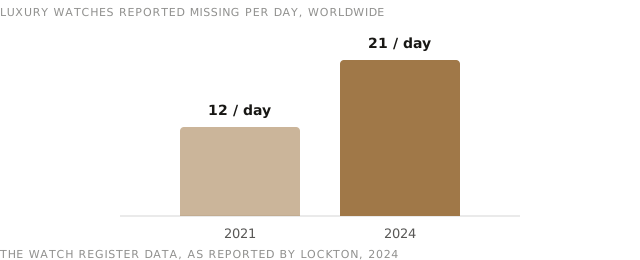
By value, £150 million of luxury watches were reported stolen worldwide in 2024, with £60 million, about 40% of the total, stemming from thefts within the UK. An average of 21 high-end watches were reported missing every day in 2024, up from 12 per day in 2021 (Lockton, reporting The Watch Register data, 2024).
Rolex remains the most targeted brand by a wide margin, accounting for 51% of watches registered as lost or stolen in 2025 and 44% of all watches checked against the database (The Watch Register, 2025, via Robb Report).
London is the recorded center of gravity. UK watch thefts rose 41% in 2022 over the year prior, with London accounting for nearly half of all cases (Lockton, 2023), and more than 6,000 luxury watches were reported stolen in London in 2022 (South China Morning Post, reporting registry and police data, 2023). Metropolitan Police disclosure data shows the total value of watches stolen in London peaked at £94.5 million in 2016 and fell to £42.1 million in 2023 (Metropolitan Police FOI disclosure, 2024). Targeted policing moves the number: undercover operations cut watch robberies in three central London boroughs from 113 to 55 in the year to July 2023, in a period when 300 watches worth £4 million had been stolen in six months (BBC News, reporting Metropolitan Police figures, 2024).
Insurers see the same curve from the claims side: underwriters surveyed reported luxury watch claims up 10% to 25% against three years prior, a mean increase of 17%, with a majority expecting further rises (The Watch Register insurer survey, via ITIJ, 2025).
How many stolen watches are recovered?
The Watch Register identified 1,375 lost and stolen watches in 2025, up 21% from 1,136 in 2024, and has traced stolen watches across 33 countries (The Watch Register, via Secured by Design, 2026). Of the watches that are recovered, half are found within a year of the loss and 35% within six months (The Watch Register, 2025, via Robb Report). Those figures describe recovered watches, not all stolen watches; no public source we could verify states what share of all stolen watches ever comes back.
The habit that drives recovery is checking. The number of businesses signing up to check watches against The Watch Register before transactions rose 42% in 2025 over 2024 (The Watch Register, 2025, via Robb Report). Every serial number checked before money changes hands is a stolen watch's chance of being found, which is also why the Watch Safe registry lookup is free for anyone.
How big is the pre-owned watch market?
The theft and counterfeit numbers above sit inside a large and growing secondary market. The pre-owned and certified pre-owned segment reached CHF 25 billion in 2024, nearly matching the market for new watches (Deloitte Swiss Watch Industry Study, 2025). Deloitte projected in 2022 that annual second-hand sales would reach CHF 35 billion by 2030 (Deloitte, via Bloomberg, 2022), and McKinsey estimated pre-owned watch sales at $18 billion in 2019 with growth toward $29 to $32 billion by 2025 (McKinsey, via The Business of Fashion).
For scale on the primary side, Swiss watch exports totaled CHF 26.0 billion in 2024, down 2.8% from 2023, of which wristwatches accounted for CHF 24.8 billion (Federation of the Swiss Watch Industry, 2025). Demand for pre-owned keeps building underneath: 40% of millennial and Gen Z respondents told Deloitte they are likely to purchase a pre-owned watch in the coming year, with 53% citing price as the main motivation, up from 44% in 2021 (Deloitte Swiss Watch Industry Study, 2025).
A bigger secondary market means more watches changing hands between strangers, which is exactly where theft and counterfeiting statistics stop being abstractions. The practical habits are unglamorous: get the serial number, check it before you pay, and if a watch of yours is taken, report it so the serial is flagged for every future search.
Sources and method
Every statistic on this page is traceable to the linked source, and the year each number refers to is stated alongside it. Primary sources, meaning government agencies, international organizations, named police forces, and industry bodies publishing their own data, are preferred; where a registry's or consultancy's annual figures are published through the press, the reporting outlet is named in the citation. Figures that circulate widely without an attributable source, including several popular counterfeit-market numbers, were checked and deliberately excluded. If a number here is out of date or you can point us to a better primary source, write to hello@watchsafe.io.
Changelog
- 2026-07-30: Page published with 30 sourced statistics across counterfeiting, border seizures, theft, recovery, and market context.